Alexander
Blu
About
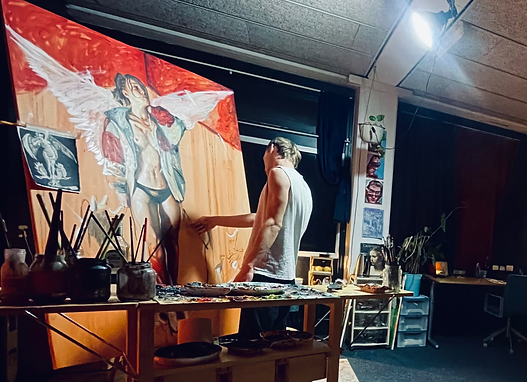
Alexander Blu - Artist
Alexander Blu’s paintings operate in the language of contemporary mythology. Their surfaces are seductive, cinematic and often beautiful, yet beneath that beauty lies a persistent atmosphere of unease.
His figures inhabit a world untethered from time—too modern to belong entirely to myth, yet too mythic to belong comfortably to the present. The work exists in the tension between memory and dream, history and the contemporary, the familiar and the archetypal.
Working predominantly in large-scale figurative oil painting, Blu explores the psychological territory between beauty and danger, the sacred and the profane, tenderness and violence. His paintings are driven less by narrative than by symbolic gravity, engaging with enduring questions of love, faith, desire, sacrifice, identity and redemption.
A Minerva Art Academy graduate with honours, Blu has exhibited widely in the Netherlands, sold work internationally, and developed an active practice within Groningen through exhibitions, events and unconventional contexts for showing painting.
The result is a fragmented contemporary mythology in which the ancient and the present occupy the same psychological world.
Education
2018-2019
City & Guilds of London Art School
2019-2023
Minerva Art Academy - Hanze, Groningen
Residencies
2022
2024
Kunsthuis SYB, Drachten
DonderBoerKamp
Selected Exhibitions
2022
2023
2023
2023
2023
Martinikerk, Groningen
Greenlights, EM2, Groningen
Graduation, 'Future', De Toekomst Groningen
Bout Advocaten, Groningen
Minerva, Anniversary, Groningen
2024
2024
2024
2025
2025
Stichting Gallery Nord, Groningen
Solo Exhibition, Kunsthandel Peter ter Braak
Dutch Design Week, Manifestations, Eindhoven
Focus2, Martini Plaza Groningen
Future of the North, Campis, Assen

Press/Reviews
Alexander Blu's paintings arrive clothed in the language of contemporary mythology. At first glance they seem familiar: beautiful women, solitary men, rifles, wolves, saints, lovers, ruins, fragments of forgotten stories. The imagery possesses the immediate seduction of cinema and fashion photography, yet to dismiss the work at that level would be to mistake the mask for the face. Beneath the surface glamour lies an atmosphere of profound unease. Blu's figures inhabit a world suspended between dream and memory. They stand as though caught between epochs: too modern to belong to myth, too mythic to belong entirely to the present. The result is a body of work that feels strangely untethered from time. A young woman leaning against a car may simultaneously evoke a fashion campaign, an icon of a forgotten saint, and a character from a folktale whose ending has long since been lost. What distinguishes Blu's work is not its subject matter but its symbolic gravity. The paintings are populated not by individuals but by archetypes. The women appear as muses, temptresses, queens, martyrs, lovers and destroyers in equal measure. The men emerge as wanderers, hunters, soldiers, saints and exiles. Their identities remain deliberately unresolved, allowing them to occupy a larger psychological territory. They become mirrors in which the viewer encounters fragments of their own desires, fears and aspirations. There is a recurring tension throughout the work between the sacred and the profane. Religious imagery appears not as doctrine but as living myth. Angels descend into contemporary landscapes. Biblical narratives are stripped of their historical distance and returned to the realm of human experience. The stories cease to be ancient events and become immediate emotional realities. In Blu's hands, heaven is not a place but a psychological condition; the battlefield of angels and demons is revealed to exist within the human heart itself. Beauty occupies a similarly complex role. Blu understands that beauty is never neutral. It attracts, seduces, wounds and transforms. His paintings resist the modern tendency to treat beauty with irony or suspicion. Instead, they approach it as earlier cultures often did: as a force bordering on the divine. Yet this beauty is never entirely comforting. It carries within it the possibility of loss, obsession and tragedy. One senses that the artist is less interested in beauty as pleasure than beauty as fate. The landscapes contribute powerfully to this atmosphere. Skies darken. Fields empty. Cities recede into silence. Nature appears not as scenery but as a stage upon which symbolic dramas unfold. Wolves, birds and other creatures emerge less as animals than as ancient messengers, reminders that beneath the veneer of modern life older instincts continue to stir. What ultimately gives the work its resonance is its refusal to provide clear answers. These paintings do not illustrate a worldview; they search for one. They are animated by questions rather than conclusions. What is worth worshipping? What is worth sacrificing for? Why does beauty so often arrive hand in hand with suffering? Why do human beings continue to build myths around love, faith, violence and redemption? In an age increasingly dominated by irony, Blu's work possesses the rare courage of sincerity. It dares to engage with subjects that contemporary culture often regards as unfashionable: transcendence, heroism, longing, spiritual hunger. Yet it does so without sentimentality. The paintings acknowledge darkness without surrendering to cynicism, and they pursue beauty without denying its dangers. Viewed together, the works form a fragmented epic—a contemporary mythology assembled from memory, religion, desire and dream. Their figures stand before us like survivors from forgotten legends, carrying wounds whose origins they cannot fully explain. We recognize them because, in some quiet and unsettling way, they are ourselves. Alexander Blu's paintings remind us that myth has never disappeared. It has merely changed its clothing.
Deep Confrontational Beauty — André Florin Wyss Deep confrontational beauty Alexander Blu is an emerging European painter based in Groningen and Brussels. Within a period of only 3 years Blu has managed to attain a maturity of thought and technique that is astounding, particularly when comparing his early works and his more recent accomplishments. The imagery of his paintings is extremely powerful and combines a subtlety of colour choice with dark backgrounds (e.g. “Despondency”, 2021) that evokes qualities of 17th century religious art whilst remaining firmly rooted in the present and without the taint of imitation. The maturing process of his oeuvre can be observed in his two studies on the Biblical theme of Judith’s beheading of Holofernes from 2020 and 2021. Whilst the former is reminiscent of 1990s street art the latter shows a maturity in the study of facial expressions that is astounding and creates a balance between overt theme of the bloody act with the deeper and covert relational reversal of female victimhood. Blu plays with subtleties of colour intensity, light/darkness and brush-stroke that seek a balance between the intensity of contrast between the “in-the face” and the subliminal message of his works. Both in his Judith studies and in his collaborative work “War in Heaven” there is a wonderful transposition between the received iconography of traditional religious art with human figures of the present. It is to be desired that Alexander Blu will continue to make such evident strides in the maturing of his already discernible individual style and the quality of equilibrium between artistic technique and thoughtful imagery in his developing career. Review by André Florin Wyss MA Euroculture, MTheol
Expressive Images of Colourful Violence - Review by Eric Bos (Dagblat van het Norden) 'Stormy', that's how one could describe the paintings of Alexander Blu (2000). His preference: dynamic images as a young man in an explosive world. Alexander Blu exhibits at Kunsthandel Peter ter Braak. He was educated in London and at the Minerva Art Academy, in Groningen, the city where he lives and works. What are his favourite themes? Violence, Disaster, he may agree, you can see that in his paintings. Phallic weapons in the hands of tough guys and sexy women; over the top, almost comical. But, it's not all satire. For example, there's a penetrating realistic portrait of a young woman whose right eye has been bashed shut. It is seen with blood, eyes peering at us. In this way, the painting brings us close to the real drama. That closed eye reminds us of the iconic portrait of the American photographer Nan Golden, after she was beaten up because of her photos of the fringes. As a counterbalance, the gallery also has a small series of paintings of Children's Toys, a bicycle rotting away in the grass; memories of youth. But to keep us focussed, a painting of the sleeping heroin addict, who seems to have wings, like an angel rising from the heroin fumes after an overdose. How can you prevent a disaster painted on a panel of a few centimetres? Alexander Blu doesn't shy away from it. Miniature paintings of explosions, a nuclear flash of light. Intense images of a world in which a nuclear disaster hangs like a shadow over our daily existence. It is work that raises questions, that confronts us with fear and danger, but that also puts everything into perspective, by giving its own twist. A contemporary expressionist with his own way of expressing himself. Alexander Blu is a contemporary expressionist who strives for his own way of expressing himself in his work. That pursuit makes it fascinating. Technique and imagination seek a balance in every painting. The tension that this evokes makes his work an experience. Sometimes he brushes everything together at a high speed, then again it is a considered process. He is not easily satisfied and tends to keep working on a finished painting. And then there hangs an attempt at mystery between all the action shots. A romantic forest scene with a full moon, and a white owl on a branch. But the sky is coloured red. Critique by Eric Bos Visualia 1497, Kunst Kijken met Eric Bos, Dagblat van het Noorden
Where timeless questions of the heart may meet the march of modern life - Melis Dumlu Through a questing return to figurative art and archetypal symbolism: as the storm of progress rages above, Blu digs deeper into the past, and a space of renewal opens up, where timeless questions of the heart may meet the march of modern life that overtakes us daily: art is what we do, and that doing renews and redefines itself. Our age is a confusion of media, a chaos of social signals and a hustle culture. Our art is trendy, often abstract. And yet, when the storm rages, returning to the timeless questions of the past is the strongest statement one can make. Through Blu's work, he engages directly with troubling questions of our time: questions that we only entertain obliquely, indirectly. Blu’s work sits on the fault lines of a conscious line of questioning: we often see work that asks complicated questions from a position of comfort. He invites the viewer to ask simple questions from a position of discomfort. Finding a sense of congruity with the saying “Het bloed kruipt waar het niet gaan kan”, his work reflects a pervasive ilk of the nature of being.